
Water Damage Restoration in Texas
Rapid water extraction, structural drying, and full restoration after a leak, storm, or flood damages your Texas property.
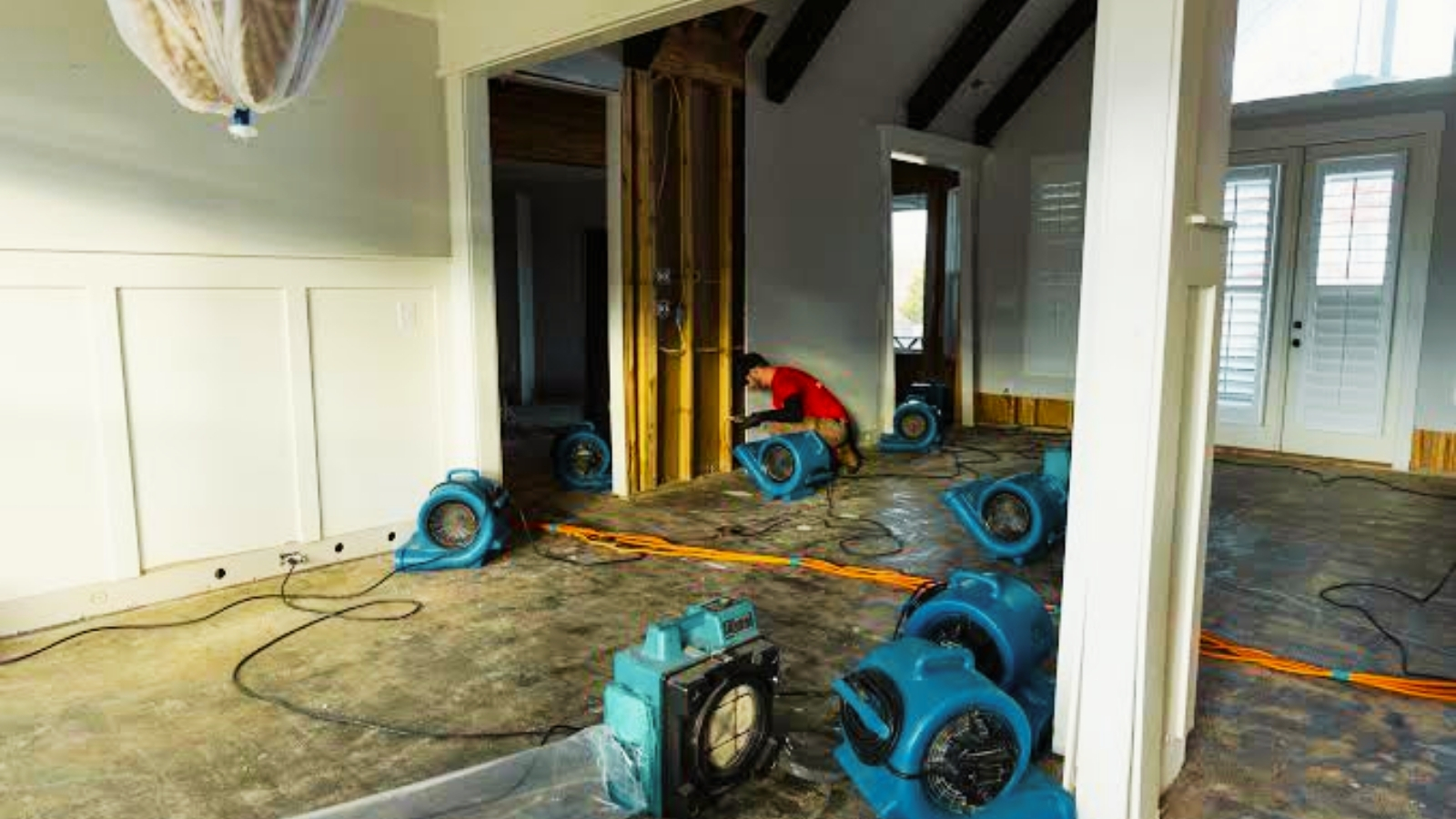
What Is Water Damage Restoration?
Water damage restoration is the full process of returning a property to a dry, safe, structurally sound condition after water has entered where it should not be. It covers four distinct jobs: removing the water, drying the structure down to a measurable target, cleaning and treating anything the water contaminated, and repairing or replacing what cannot be saved.
The part most people underestimate is drying. Removing visible water takes hours. Drying the materials that absorbed it takes days, because water wicks upward into drywall, travels along joists, soaks into subfloor, and collects inside wall cavities where nothing looks wet from the outside. A room can feel dry to the touch while the framing behind it still reads saturated on a moisture meter.
Our work follows the IICRC S500 standard, which is the industry reference for water damage restoration. That standard is why we categorize the water, document moisture readings daily, and dry to a verified target rather than stopping when a room looks finished.
Water damage can start small — a slow leak behind a wall, a failed appliance hose, an overflowing tub — and escalate fast. Within 24 to 48 hours, standing water and trapped moisture can warp flooring, weaken drywall, and create the conditions mold needs to grow.
Water damage restoration is the process of removing standing water, drying out the structure, and repairing anything that was damaged along the way. It combines fast action with the right equipment: pumps, extraction tools, industrial air movers, and dehumidifiers.
What To Do Right Now
The steps that limit damage, and the common reactions that make it worse.
Do This Now
- Shut off the water supply at the fixture or at the main if the source is still running
- Cut power to affected rooms at the breaker, but only if you can reach the panel without standing in water
- Move furniture, electronics, and documents out of the wet area if it is safe to do so
- Lift curtains and drapes off wet flooring and put foil or wood blocks under furniture legs
- Photograph and video everything before anything is moved or cleaned, for your claim
- Open windows only if the outside air is drier than the inside air, which in much of Texas it often is not
Avoid Doing This
- ×Do not use a household vacuum to pull up standing water
- ×Do not enter a room with sagging ceilings or visible ceiling bulges, which can hold hundreds of pounds of water
- ×Do not turn on ceiling fans or lights in a room where water has reached wiring or fixtures
- ×Do not leave wet carpet in place assuming it will dry, since the padding beneath holds water far longer
- ×Do not treat sewage or floodwater as a cleanup you can handle yourself
- ×Do not wait for the insurance adjuster before starting mitigation, since most policies require you to prevent further damage
What Causes Water Damage Restoration Situations
Understanding the source matters, because the same failure repeats until it is addressed.
Plumbing Failures
Supply lines, shut-off valves, and pipe joints fail with age. A quarter-inch supply line can move hundreds of gallons in a day if nobody is home.
Appliance Leaks
Water heaters, washing machines, dishwashers, and refrigerator ice lines are the most common household sources, usually from a split hose or a failed pan.
Storm and Roof Intrusion
Hail-damaged shingles, wind-lifted flashing, and clogged gutters let rain into attics and wall cavities where it goes unnoticed for weeks.
Winter Freeze Bursts
Unprotected pipes in attics, garages, and exterior walls split when temperatures drop, then release water the moment the line thaws.
Slow Hidden Leaks
A pinhole leak behind a wall or under a slab can run for months, showing up first as a warm floor spot, a musty smell, or a water bill that climbed without explanation.
Foundation and Grading Issues
Poor drainage and expansive clay soil push water against and under slabs, particularly across the Blackland Prairie belt of North and Central Texas.
How To Tell You Need This Service
Signs To Watch For
- Staining, bubbling, or discoloration on walls and ceilings
- Flooring that cups, buckles, lifts at the seams, or feels soft underfoot
- A persistent musty smell that returns after you clean
- Baseboards separating from the wall or showing a dark waterline
- Unexplained increases in your water bill
- Warm or damp spots on a slab floor, which often indicate a hot-water slab leak
- Condensation on windows and a room that feels humid compared with the rest of the house
When This Service Applies
- A pipe bursts or a supply line fails
- An appliance (washer, water heater, dishwasher) leaks or floods
- Heavy rain or storm runoff enters through a roof, window, or foundation
- A slow, hidden leak is discovered behind a wall or under flooring
Problems It Solves
- Standing water soaking into flooring, subfloor, and drywall
- Warped hardwood, buckled laminate, or saturated carpet padding
- Weakened structural framing from prolonged moisture exposure
- Electrical hazards from water near outlets or wiring
- Musty odors and the early stages of mold growth
What Happens While You Wait
Damage progresses on its own schedule. This is roughly how it unfolds.
Water Spreads
Water migrates along the path of least resistance, soaking into drywall, carpet padding, and subfloor. Finishes begin absorbing immediately and furniture legs start staining carpet.
Mold Window Opens
Mold can begin establishing in consistently wet materials in roughly 24 to 48 hours. Clean water also degrades toward contaminated water across this window as it picks up soil and bacteria.
Structural Damage
Drywall loses integrity, wood swells and warps, and metal fasteners begin corroding. Mold colonies spread through wall cavities and into HVAC runs.
Major Reconstruction
What began as a drying job becomes demolition and rebuild. Contamination risk rises, occupancy may be unsafe, and insurers scrutinize delayed mitigation more closely.
Our Process
What actually happens from the first call through to final verification.
- 1
Inspection & Assessment
Our technician identifies the water source, categorizes the water type, and assesses how far moisture has traveled.
- 2
Water Extraction
Standing water is removed using pumps and extraction equipment to stop further absorption into materials.
- 3
Drying & Dehumidification
Industrial air movers and dehumidifiers dry out structural materials, monitored daily with moisture meters.
- 4
Cleaning & Sanitizing
Affected surfaces are cleaned and treated to prevent odor and microbial growth.
- 5
Repair & Restoration
Damaged drywall, flooring, or framing is repaired so your property is returned to its pre-loss condition.
The Equipment We Use
Restoration outcomes depend on the right equipment used correctly, and on measuring the result.
Truck-Mounted and Portable Extractors
High-capacity extraction removes standing water and pulls trapped water out of carpet and padding before drying begins.
Centrifugal Air Movers
Air movers are positioned to create directed airflow across wet surfaces, which accelerates evaporation from materials into the air.
LGR Dehumidifiers
Low-grain refrigerant dehumidifiers pull that evaporated moisture back out of the air so the structure keeps releasing water instead of reaching equilibrium.
Moisture Meters and Thermal Imaging
Penetrating and non-penetrating meters establish moisture content in materials, while thermal cameras reveal temperature differences that indicate hidden water.
Antimicrobial Treatment
EPA-registered products are applied to affected surfaces to inhibit microbial growth during the drying period.
Daily Monitoring Logs
Readings are recorded each day at the same points so progress is provable and the drying endpoint is a number rather than an opinion.
Water Categories and Classes
Two separate scales govern how a water loss is handled. Category describes how contaminated the water is, which determines safety requirements and what can be salvaged. Class describes how much material is wet and how hard it will be to dry, which determines how much equipment is needed and for how long.
Clean Water
Water from a sanitary source such as a supply line, a water heater, or a toilet tank. It poses no immediate health risk, but it degrades to Category 2 within roughly 24 to 48 hours as it contacts building materials and soil.
Gray Water
Water carrying significant contamination that can cause illness on contact, such as washing machine or dishwasher discharge, toilet overflow containing urine, or Category 1 water that has sat too long. Porous materials often cannot be saved.
Black Water
Grossly contaminated water that may carry pathogens and toxins, including sewage backups, rising floodwater from outside, and any water that has stood long enough to support microbial growth. This requires containment, protective equipment, and disposal of most affected porous materials.
Drying Difficulty
Class 1 means a small area with minimal absorption. Class 2 involves an entire room with carpet and wicking up walls. Class 3 means water came from overhead and saturated ceilings, walls, insulation, and subfloor. Class 4 covers deeply held water in low-permeability materials such as hardwood, plaster, and concrete, which need specialty drying systems and longer schedules.
What's Included
- Water extraction and moisture mapping
- Structural drying with monitored equipment
- Mold-prevention treatment of affected areas
- Repair of damaged drywall, baseboards, and flooring
- Documentation to support your insurance claim
Homes and Businesses
The work differs depending on what the building has to do once we leave.
Residential
In homes, the priority is getting the family back into a safe, livable space without tearing out more than necessary. We work room by room, protect contents, set containment where demolition is unavoidable, and keep equipment noise and disruption as contained as we can. Where a home has pier-and-beam construction or a crawl space, which is common in older Texas housing stock, we check underneath, because water that drains below the floor will keep feeding humidity into the rooms above.
Commercial
For businesses, downtime is usually the larger loss. We sequence work so the most critical areas get dried and released first, coordinate around operating hours where possible, and document everything to the standard a commercial carrier expects. Multi-tenant buildings add complications in shared walls, shared HVAC, and water that crosses lease lines, so we map the full extent before equipment goes in rather than treating one unit in isolation.
Working With Your Insurance
Most Texas homeowner policies cover sudden and accidental water damage, such as a burst supply line or a failed water heater. Damage from long-term seepage, gradual leaks, or deferred maintenance is commonly excluded, which is why documenting the point of failure matters so much.
Water that enters from outside at ground level is treated as flood, and standard homeowner policies exclude it. That coverage comes from a separate flood policy, typically through the National Flood Insurance Program or a private flood carrier.
Policies generally obligate you to mitigate, meaning you are expected to take reasonable steps to stop further damage rather than waiting for an adjuster. Starting professional mitigation promptly usually supports your claim rather than jeopardizing it.
We photograph conditions before we touch anything, log daily moisture readings, itemize removed materials, and produce scope documentation your adjuster can verify. We coordinate directly with most major carriers, though the coverage decision always rests with your insurer.
What We Provide For Your Claim
Photo documentation of conditions before work begins, daily readings logged throughout, an itemized record of affected materials, and scope documentation your adjuster can verify. We coordinate directly with most major carriers. The coverage decision always rests with your insurer, and we do not promise an outcome.
What Affects the Cost
We assess the property before quoting, because the variables below change the scope substantially.
- Square footage affected and how many rooms or floors the water reached
- Water category, since contaminated water requires containment, protective equipment, and disposal
- Drying class, which determines how much equipment runs and for how many days
- Which materials got wet, as hardwood, plaster, and tile assemblies dry far more slowly than carpet
- How much controlled demolition is needed to reach trapped moisture
- Whether contents require cleaning, drying, or off-site storage
- Access difficulty, including crawl spaces, second stories, and tight utility areas
- Whether reconstruction follows mitigation, and the finish level being restored
Why We Don't Quote Over the Phone
A figure given before anyone has seen the property is a guess, and the guesses that sound attractive on the phone tend to grow once work starts. We inspect, scope the job against what we actually find, and give you that in writing.
How Long It Takes
For a contained loss in one or two rooms, structural drying commonly runs three to five days with daily monitoring. The equipment stays until the readings hit target, which is why we avoid promising a finish date on day one.
Water that reached subfloor, wall cavities, or multiple rooms extends drying, often to a week or more. Class 4 situations involving hardwood, plaster, or concrete can run longer still because those materials release moisture slowly.
Reconstruction is a separate phase that begins after drying is verified. Its length depends on what has to be rebuilt, how quickly materials can be sourced, and whether your carrier has approved the scope.
Why Texans Choose Us for Water Damage Restoration
We Dry to a Number
Equipment comes out when moisture readings meet the drying goal for those materials, not when the room looks dry or the schedule says so.
Same-Night Dispatch
Water damage worsens by the hour. Our line is staffed around the clock and we dispatch as soon as we understand what you are dealing with.
Claim-Ready Documentation
Photos, moisture logs, material inventories, and scope notes are produced as we work so your adjuster has a verifiable record.
Statewide Coverage
We reach properties in 926 Texas cities across all 254 counties, including rural addresses that national franchises often will not service.
Water Damage Restoration Across Texas
Texas sees a wide range of water damage triggers — Gulf Coast humidity and tropical storm systems, sudden hailstorms that damage roofing, and winter freezes that burst unprotected pipes across Central and North Texas. Acting quickly matters everywhere in the state, since the warm, humid climate common to much of Texas accelerates mold growth once materials stay wet.
247 Restore Texas provides licensed, insured water damage restoration across all 926 Texas cities we cover, from major metros to small communities and unincorporated areas. Rural properties get the same equipment, process, and documentation as metro jobs.See all service areas →
Water Damage Restoration in Your City
Select a major metro, or browse the full statewide directory.
Services That Often Go Together
Flood Damage Cleanup
Emergency flood water removal and cleanup for Texas homes and businesses impacted by storms, heavy rain, or overflow flooding.
Burst Pipe Repair & Cleanup
Emergency cleanup and water damage repair following a burst or frozen pipe inside your Texas home or business.
Sewage Cleanup & Restoration
Safe, sanitary sewage backup cleanup and restoration for Texas properties affected by sewer line failures and black water intrusion.
Mold Remediation
Certified mold remediation to safely remove mold colonies and address the moisture source in Texas homes and businesses.
Frequently Asked Questions
How fast should water damage be addressed?
As soon as possible — ideally within 24-48 hours — to reduce the risk of structural damage and mold growth.
Is water damage restoration covered by homeowners insurance?
Many policies cover sudden, accidental water damage (like a burst pipe), but coverage varies. Review your policy or ask our team for guidance.
Can I stay in my home during water damage restoration?
In many cases, yes, especially for smaller or contained incidents. Our technician will advise if any area needs to be vacated.
How long does the drying process take?
Typically 3-5 days depending on the extent of water intrusion and the materials affected.
What is the difference between water damage restoration and flood cleanup?
Water damage restoration generally refers to clean-water incidents like pipe leaks, while flood cleanup addresses larger-scale water intrusion from storms or external flooding, often involving contaminated water.
How do you know when the structure is actually dry?
We take baseline readings from unaffected materials of the same type, then dry until the affected materials reach that same moisture content. Readings are logged daily at fixed points, so the endpoint is documented rather than estimated.
Will you have to tear out my walls and flooring?
Not always. Many assemblies can be dried in place using targeted airflow and injection drying. We remove material when it is contaminated, structurally compromised, or holding water that cannot be reached any other way, and we tell you why before we cut.
What is the difference between water damage and flood damage?
In insurance terms, flood means water that enters from outside at ground level, including storm surge and rising creeks. Water damage from an internal source such as a burst pipe is a different peril, covered under most standard homeowner policies while flood is not.
Can water damage cause problems months later?
Yes, and it commonly does when drying was incomplete. Trapped moisture shows up later as cupped flooring, peeling paint, recurring musty odor, or mold inside wall cavities. Verified drying at the time is what prevents that.
Do you work on slab leaks?
Yes. We locate the affected area, coordinate the plumbing repair, then dry the slab and surrounding assemblies. Concrete releases moisture slowly, so slab drying generally takes longer than a surface loss of similar size.
Need Water Damage Restoration Now?
Get a licensed technician to your property. Free estimate, no obligation.
Call Now — (866) 370-1338